Service Hotline : 0757-22332275
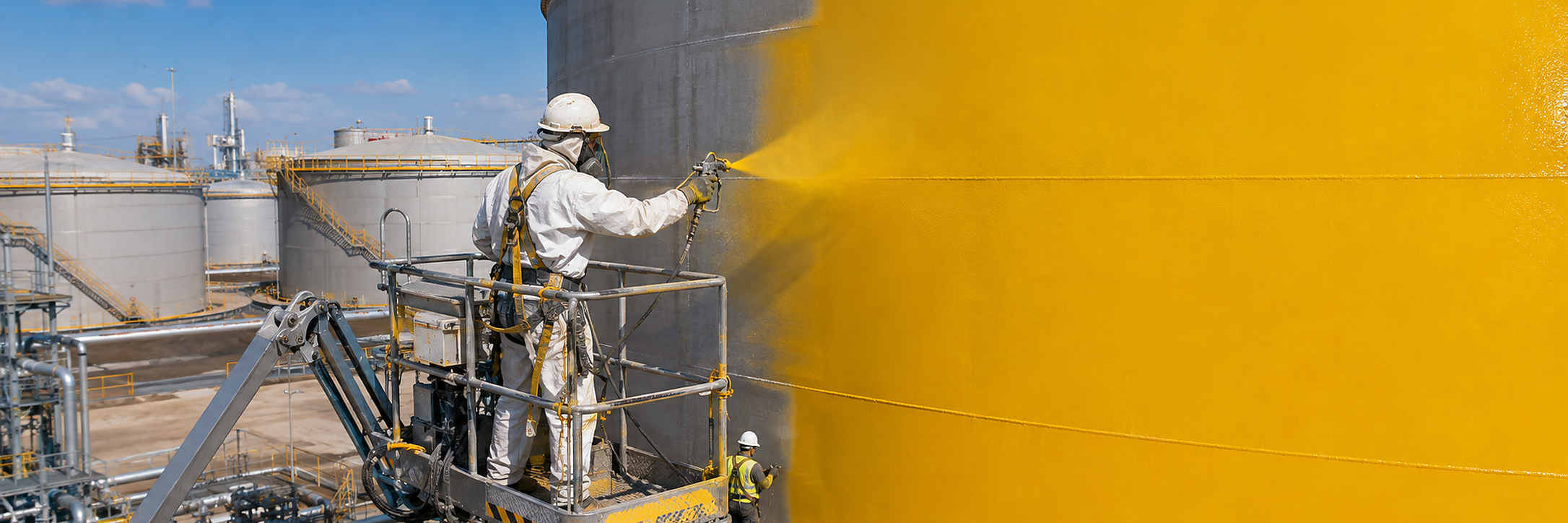
SteaShield® 10W is an ultra-lamellar talc developed for high-value paints and coating systems that require improved physical barrier performance.
Unlike conventional talc grades used mainly for filling, application-property adjustment, or cost control, SteaShield® 10W places greater emphasis on particle morphology and lamellar structure. Once properly dispersed within a coating film, its plate-like particles can increase the distance that water, oxygen, salts, and migrating contaminants must travel before reaching the substrate.
This makes SteaShield® 10W particularly suitable for anti-corrosion coatings, stain-blocking paints, barrier primers, and other protective coating systems.
SteaShield® 10W is also densified to provide higher bulk density. This can improve packaging and transportation efficiency while helping reduce dust during powder handling and addition.
During long-term exposure, coating films are continuously challenged by moisture, oxygen, dissolved salts, and other external contaminants.
These substances may gradually move through:
Micropores in the coating film
Interfaces between pigments and binders
Gaps created during film formation
Defects caused by aging or environmental exposure
Conventional filler particles may increase solids content without significantly changing the direction of permeation. Plate-like particles, however, can create a more complex internal structure.
When SteaShield® 10W is well dispersed, its lamellar particles overlap and form a more tortuous path through the coating film. Moisture and corrosive substances must travel around these particles rather than moving directly toward the substrate.
This mechanism is commonly described as the tortuous path effect.
The resulting barrier structure can help:
Lengthen the permeation path of water and oxygen
Limit the movement of soluble salts toward metal substrates
Reduce the migration rate of stains and contaminants
Strengthen the physical barrier function of primers and topcoats
Support the long-term stability of high-barrier coating systems
Water, oxygen, and dissolved salts are major external contributors to metal corrosion.
SteaShield® 10W can be incorporated as a barrier mineral filler to increase resistance to the movement of these substances through the coating film. It is suitable for anti-corrosion primers, intermediate coats, and protective coatings where improved physical barrier performance is required.
Typical application areas include:
Industrial anti-corrosion primers
Metal protection coatings
Maintenance coatings for industrial equipment
High-barrier intermediate coats
General industrial protective coatings
SteaShield® 10W primarily contributes physical barrier protection. It should not be expected to provide the entire anti-corrosion mechanism by itself.
A complete anti-corrosion system still depends on:
Binder selection
Anti-corrosive pigments
Substrate preparation
Dry film thickness
Curing conditions
Compatibility between coating layers
Smoke stains, watermarks, tannins, dyes, and other soluble contaminants may migrate from a substrate or an old coating into a newly applied finish.
This migration can cause:
Discoloration
Yellowing
Stain bleed
Uneven appearance
Localized color differences
The plate-like structure of SteaShield® 10W can increase the path that migrating contaminants must travel through the coating film.
It is suitable for:
Stain-blocking primers
Contaminant-sealing coatings
Renovation primers
Substrate-isolation coatings
High-barrier architectural primers
Its primary role is to improve physical isolation and reduce the probability of contaminants rapidly reaching subsequent coating layers.
SteaShield® 10W can be used in primers, intermediate coats, and selected topcoat systems where increased film density and barrier performance are required.
In a primer, it can help establish the first protective barrier over the substrate. In an intermediate coat or topcoat, it can further increase the difficulty of moisture and contaminants penetrating the complete coating system.
Potential applications include:
Barrier primers
High-performance intermediate coats
Water-resistant protective coatings
Stain-resistant coating systems
High-value industrial finishes
SteaShield® 10W can also be used as a functional mineral filler in architectural coatings where moisture resistance, stain isolation, and protective performance are important.
Suitable product categories may include:
Interior stain-blocking primers
Wall-sealing primers
Renovation coatings
Coatings for moisture-prone substrates
High-performance architectural protection coatings
The following table compares the general application positioning of SteaShield® 10W with conventional talc. Actual conventional talc performance can vary depending on mineral source, processing method, particle size distribution, and grade.
Comparison Item | SteaShield® 10W | Conventional Talc |
Product Positioning | Ultra-lamellar functional talc | General-purpose mineral filler |
Particles structure | Emphasizes high lamellarity and plate-like morphology | Naturally lamellar, but the retained plate structure varies by grade and processing |
Processing objective | Designed to preserve a strong lamellar structure | Conventional grinding may reduce the integrity of some plate-like particles |
Main formulation function | Barrier enhancement, stain isolation, and anti-corrosion support | Filling, application adjustment, sanding improvement, and cost control |
Moisture barrier contribution | Suitable for coating systems with higher barrier requirements | May provide some support, but barrier performance is usually not the primary function |
Corrosive media resistance | Suitable for high-performance protective coatings | More commonly used in general anti-corrosion and filling applications |
Stain migration control | Suitable for stain-blocking and isolation coatings | Generally provides less targeted control of contaminant migration |
Typical application level | High-value primers, intermediate coats, and selected topcoats | General industrial and architectural coatings |
Bulk and transportation | Densified to provide higher bulk density | Depends on the specific grade; some grades may have relatively low bulk density |
Dust during handling | Densification helps reduce dust during handling | Dust levels depend on particle size, packaging, and powder processing |
Cost positioning | Functional mineral focused on performance contribution | Usually selected for filling efficiency and raw-material cost control |
Selection basis | Suitable when barrier performance and product differentiation are priorities | Suitable when basic filling performance and cost efficiency are priorities |
A coating may have sufficient dry film thickness but still contain permeation pathways through micropores, binder-filler interfaces, or poorly organized filler structures.
SteaShield® 10W uses plate-like particles to create a more complex route through the film.
It can help address:
Rapid moisture penetration
Insufficient oxygen barrier performance
Incomplete barrier structure
Limited functional contribution from conventional fillers
Its value comes mainly from particle morphology rather than simply increasing filler loading.
Anti-corrosion performance depends not only on anti-corrosive pigments but also on the coating film’s ability to restrict water, oxygen, and salt movement.
SteaShield® 10W can create an overlapping lamellar structure within the film, helping delay the movement of corrosive substances toward the metal surface.
It may be considered when addressing:
Insufficient physical barrier protection
Rapid movement of moisture and salts toward the substrate
Limited barrier contribution from conventional talc
The need to improve the durability of an existing protective coating
The challenge in stain-blocking applications is not only hiding a stain. The coating must also prevent contaminants from continuing to migrate into the finish.
SteaShield® 10W can increase the diffusion path of migrating substances and may help reduce:
Smoke-stain bleed
Watermark reappearance
Substrate discoloration
Uneven appearance after renovation
Insufficient isolation by the primer
Increasing the amount of conventional talc does not necessarily produce a proportional improvement in barrier performance.
When a formulation objective shifts from cost reduction toward durability and product differentiation, particle morphology can become more important than filler dosage alone.
SteaShield® 10W is suitable for formulation strategies focused on:
Upgrading from general-purpose fillers to functional fillers
Increasing the performance contribution of the mineral phase
Adding a clear barrier-performance benefit
Developing higher-value anti-corrosion coatings
Developing stain-blocking or isolation coatings
Improving the internal barrier structure of an existing formulation
Low-bulk-density powders can occupy more packaging and storage space while generating significant dust during bag opening and addition.
The densified form of SteaShield® 10W can help:
Improve transportation efficiency per unit of packaging
Reduce dust during powder addition
Improve production-area cleanliness
Support more convenient powder metering and conveying
Reduce handling losses associated with lightweight powders
The practical effect will depend on plant layout, conveying equipment, addition method, and dust-control systems.
SteaShield® 10W is a functional ultra-lamellar talc developed for anti-corrosion coatings, stain-blocking paints, and high-barrier coating systems.
Its plate-like particles can form a more tortuous internal path through the coating film, increasing the difficulty of water, oxygen, salts, and migrating contaminants reaching the substrate or penetrating subsequent coating layers.
Compared with conventional talc, SteaShield® 10W is more suitable for formulations in which barrier performance, durability, and product differentiation are primary development objectives.
Conventional talc remains appropriate for coatings focused mainly on filling efficiency and cost control. SteaShield® 10W is better positioned for higher-value systems where the mineral filler is expected to make a more defined contribution to coating performance.



NMT@fszhaojing.com
0757-22332275
Unit 3011, 30th Floor, Building 1, Poly Commercial Center, No. 3 Guotai South Road, Daliang Street, Shunde District, Foshan City, Guangdong Province


NMT@fszhaojing.com
0757-22332275
Unit 3011, 30th Floor, Building 1, Poly Commercial Center, No. 3 Guotai South Road, Daliang Street, Shunde District, Foshan City, Guangdong Province


 SA
SA ES
ES FR
FR